.svg)
.svg)

Let’s stay in touch with the ShipHero Blog.


.png)
While your team is still walking aisles, your competitors are cutting pick times in half with automation. Guess who’s shipping faster and stealing market share?
Automation isn't the future anymore. It's the present. For growing eCommerce brands or fulfillment centers under pressure to deliver faster, cheaper, and more accurately, automated warehouse picking systems are no longer a luxury. They're a necessity.
In this guide, you'll learn how automated picking systems work, the types available, how to choose the right one, and how ShipHero can help you streamline fulfillment processes with confidence.
Automated warehouse picking systems use software, robotics, and real-time data to locate, retrieve, and prepare items for shipment, without relying solely on human labor. Instead of employees walking long distances and manually selecting items, automated systems bring items to workers or direct them with tools like lights, voice commands, or mobile robots.
For example, in the eCommerce space, brands use Goods-to-Person (GTP) systems to increase operational efficiency and efficiently handle large catalogs of SKUs. In retail, where seasonal order surges can overwhelm manual processes, automated solutions help companies double their picking speed and maintain consistent fulfillment even during peak demand.
The process is surprisingly seamless:
This flow is driven by smart software that integrates with warehouse management systems and supports key warehouse processes, including picking, packing, and tracking real-time inventory.
Want a deeper look at the tech behind it? Read this guide on warehouse automation software.
There’s no universal solution for warehouse automation. The best picking system depends on your space, order volume, and the variety of products you offer. Some work better for high-SKU, high-volume operations; others are ideal for smaller, more focused setups. Below, we break down the top systems and which warehouse types they’re best suited for.
GTP systems deliver inventory directly to a stationary picker, eliminating walking marathons. This setup enhances inventory management, reduces physical strain on workers, and improves worker safety.
It also optimizes order accuracy by minimizing human error. By minimizing walking time and keeping pickers in one place, GTP systems significantly boost pick rates while also cutting down on labor fatigue.
Pick-to-Light is an automated solution that uses LED light bars to guide workers to the right location for picking items, enhancing accuracy, speed, and efficiency while reducing errors.
When paired with Pack-to-Light and Receive-to-Light, your entire workflow is streamlined. Pack-to-Light ensures precise packing, while Receive-to-Light optimizes inventory storage and retrieval. Together, these technologies simplify inventory management, reduce labor costs, and accelerate fulfillment.
At ShipHero, we offer all three solutions, Pick-to-Light, Pack-to-Light, and Receive-to-Light, under one roof, seamlessly integrating with your existing systems to optimize warehouse operations. The combination can help boost efficiency by 20% while also cutting costs by up to 30% for batches of 10 to 30 orders.
Pickers wear headsets and follow voice commands to locate items, like a GPS for your warehouse. This hands-free approach automates repetitive tasks, shortens training time, and reduces picking errors, even in noisy environments. It also improves accuracy, even in noisy environments where traditional methods might fall short.
AMRs, or autonomous mobile robots, navigate the warehouse floor independently, delivering items or bins to human workers or packing stations.
Unlike fixed systems, AMRs offer greater flexibility and adapt to varying warehouse sizes, support scalable operations, and offer the flexibility to grow without major infrastructure changes. They’re also highly scalable, which makes them a smart choice for warehouses looking to grow or adjust operations without major infrastructure changes.
These are high-tech racking systems equipped with robotic cranes or shuttles that automatically store and retrieve inventory. They’re especially well-suited for large warehouses with high inventory turnover, where speed and space efficiency are critical.
Businesses that need to maximize vertical storage find these systems invaluable, and industries such as pharmaceuticals, automotive, and electronics often benefit the most from their precision and scalability.
Still not convinced? The real-world benefits speak for themselves. Automation significantly reduces human error, particularly in fast-paced warehouse environments where accuracy is crucial. It also speeds up fulfillment, often cutting pick times in half or more.
By streamlining operations, businesses can lower labor costs by either reducing headcount or reassigning team members to more valuable tasks.
By transitioning to automation, companies often see dramatic improvements in efficiency and cost savings. For example, automation can reduce warehouse labor costs by up to 60%, allowing businesses to reallocate resources and scale more effectively.
It’s not always smooth sailing when implementing automated picking systems. One of the biggest hurdles is the high initial investment, as hardware, software, and integration can come with a steep upfront cost.
Staff training is another challenge, as teams need time to learn how to use the new technology effectively. There can also be short-term disruption; installation and onboarding may temporarily slow down operations. But the long-term gains are often worth it.
For example, James Enterprise struggled with paper-based picking and processing delays before switching to ShipHero’s Warehouse Management System.
The transition required workflow changes and staff training, but with proper planning, such as going paperless, reorganizing their layout, and utilizing smart pick paths, they boosted productivity by 38%. New hires cut their pick time from 55 to 34 seconds in just five days, proving that smart automation pays off.
Finding the right automated picking system starts with understanding your specific needs. Warehouse size plays a big role, as larger spaces often benefit most from solutions like AMRs or AS/RS that can cover more ground efficiently. If your business manages a high variety of SKUs, systems like GTP or voice picking can offer the flexibility and accuracy you need.
For those working with tighter budgets, starting with light-based or voice-guided systems can provide a solid foundation without breaking the bank. Regardless of your starting point, scalability is crucial; your system should be able to grow in tandem with your business. Partnering with ShipHero ensures you get expert, customized guidance and future-proof solutions designed specifically for your operation.
Implementing warehouse picking automation isn’t just about installing new tech; it’s about doing it strategically. To get the most out of your investment and avoid common pitfalls, follow these proven best practices:
Best Practices for Successful Warehouse Picking Automation
For example, Black Wolf Nation and its 3PL arm, ONE23 Fulfillment, partnered with ShipHero to scale their operations. By adopting ShipHero's warehouse management software, they increased their order volume from 10,000 to over 25,000 per month in less than a year. This strategic implementation allowed them to efficiently manage growth and expand into the 3PL space.
Most companies see a return on investment within 12 to 24 months, depending on the system and order volume.
Yes. Many automated systems are designed to be scalable and cost-effective, which makes them ideal for small warehouses. Solutions like Pick-to-Light and voice picking can start small and expand as your operation grows.
Yes. Advanced systems feature adjustable grippers, sensors, and packaging logic to safely handle delicate or irregularly shaped products.
Warehouse management systems make daily warehouse operations efficient. And wave planning is at the heart of it.
As part of the supply chain industry where efficiency is of utmost importance, the fast-paced environment of warehouse management requires every aspect of operations to work on schedule. This is where wave planning comes into play and brings efficiency to the table.
It integrates with warehouse management systems and streamlines end-to-end warehouse operations to meet customer expectations of fast shipping and real-time updates.
Wave planning batches orders for optimized picking routes, shipping, and priority. It supports operational workflows and integrates with warehouse wave picking strategies to maximize productivity, reduce errors, and improve overall daily warehouse output.
This turns warehouse operations into an organized process of handling and systematizing hundreds of orders a day.
Applying the best practices for wave management allows for maximum efficiency in managing daily warehouse operations. Start with these:
Not all orders need to be shipped at the same time. Some can wait, others can’t. Strategic planning means prioritizing orders based on shipping deadlines to ensure they are shipped out and delivered on time. This increases customer satisfaction and overall operational efficiency. To better understand the core workflows that make this strategy effective, explore how we have explained the six key warehouse processes.
Accessing real-time data allows you to monitor every wave that’s happening, from orders getting picked up to those that are delayed. This lets you take action accordingly, especially when spotting issues as they are happening.
Downtimes are red flags in wave management. They are equal to unproductivity and possible shipment delays, both affecting operations to meet quotas and customer satisfaction.
Reduce idle time in operations with these methods:
High-demand periods like holidays, promotions, and occasional spikes can cause chaos, especially if you don’t have a plan in place. That chaos can overwhelm your normal operations and lead to delays and unsatisfied customers.
Avoid this by ensuring scalability for peak periods with effective wave planning:
If you’re preparing your warehouse for high-volume fulfillment, it may be worth exploring how automated warehouse picking systems can make wave execution more efficient and adaptable.
Warehouses have different zones to which pickers are assigned.
Having specific picking zones gives structure to the picking process, making it easier to execute even through high-volume orders.Having defined picking zones helps:
Wave management gives you the flexibility to adapt quickly when an unexpected change occurs during operations.
A common issue often faced in wave management is the sudden changes in order volume. This disrupts the flow of current waves and may have an avalanche effect on the whole operation if not solved immediately.
Here’s how wave management adjusts operations to meet demand fluctuations:
A warehouse management system creates an overall plan that controls the flow of a warehouse's production. Using tools and automation, a WMS simplifies and streamlines wave management to execute warehouse operations from fulfillment to packing and delivery.
The main difference between wave planning and wave management is that the former is where the strategizing happens, while the latter is the execution and overseeing that the plan takes place.
Wave planning is the strategic part of grouping what orders should be fulfilled together, setting the time for wave releases, and adjusting them based on warehouse capacity and labor availability.
Wave management is the main operational part where the production happens. It tracks the real-time progress of wave execution to ensure things are running smoothly according to plan.
The main difference between digital and wholesale waves lies in their order size, wave planning, and operational goal. Due to their differences, each wave type requires different planning and strategy.
Digital waves service the B2C channel, are high in volume, and often have small, single-item orders that require urgent or same-day deliveries. The wave strategy used is frequent and short for flexibility. For this wave type, warehouse managers use WMS-integrated mobile devices for tech support
Meanwhile, wholesale waves are for bulk orders, often for retail distribution, resellers, or B2B supply chains. Wholesale waves have a lower order volume with large shipments and more flexible timelines.
Yes, it can be used if they have large volumes of orders per day, orders with time-blocked pickups, or group orders with shipping deadlines.
Yes. eCommerce and retail, grocery and food distribution, healthcare and pharmaceutical, industrial supply, and consumer packaged goods industries are industries that benefit from wave planning. These are industries with high order volume, delivery sensitivity, and high operational complexity.
Yes, wave management is designed to make warehouse operations, including same-day shipping, possible. Wave management creates a structure that speeds up the order fulfillment, speeding up the process for all warehouse operations, such as same-day shipping.
Your warehouse isn’t slow because your team isn’t working hard. It’s slow because they’re working inefficiently. When every picker is chasing orders in random directions, you lose time, increase errors, and risk customer satisfaction.
Wave picking fixes that by turning chaos into coordination. By grouping orders for optimized picking routes and releasing them in scheduled “waves,” you can streamline picking, reduce walking time, and enhance picking speed, especially in high-volume eCommerce environments.
In this guide, we’ll explain what wave picking is, how it works, and how to use it to run a faster, leaner, and more accurate warehouse.
Wave picking is a warehouse picking strategy where orders are grouped and released in scheduled “waves” throughout the day. Each wave organizes orders based on factors like delivery time, product type, or warehouse zone, to help your team pick faster, move smarter, and stay organized. When paired with automated warehouse picking systems, wave picking becomes even more powerful, and minimizes manual effort while maximizing speed and accuracy.
For example, a warehouse might group all orders that need same-day shipping into a morning wave, while standard shipping orders are picked in the afternoon. This keeps the flow structured and reduces chaos on the floor.
Brands using wave picking have seen measurable results. A study published in Acta Logistica found that accurately batching and releasing orders in structured waves reduced cycle times by more than 13% compared to unplanned methods, proving how it standardizes warehouse processes and improves resource utilization. This demonstrates how even modest changes in picking structure can lead to significant gains in warehouse efficiency.
Wave picking operates through a structured, three-phase process: pre-wave, wave, and post-wave.
Each stage plays a critical role in coordinating order fulfillment, from organizing batches of orders to guiding pickers efficiently through the warehouse and ensuring fast, accurate packing and shipping. Understanding how each phase works is key to unlocking the full efficiency potential of wave picking.
Before picking begins, the warehouse management system (WMS) organizes inventory for efficiency by grouping orders into waves based on factors like shipping deadlines, SKU type, or zone. It then generates batch pick lists, allocates resources, and ensures that equipment and carts are ready, laying the groundwork for a smooth picking process using proven picking strategies.
Good Company, a 3PL provider, exemplified this by leveraging ShipHero's multi-item batch feature. This streamlined their pre-wave setup, enabling them to group multiple orders with shared items into single picking runs. This drastically reduced picker travel, and as they scaled from 500-600 to 6,000-10,000 units daily within 18 months, allowed them to halve their pick time. This demonstrates the immense power of an optimized pre-wave process.
Once a wave begins, pickers follow optimized routes through the warehouse to collect items. The goal is to reduce backtracking and congestion by assigning pickers to specific zones or paths.
E-Commerce Xpress, an eCommerce fulfillment provider, has significantly streamlined its picking process by adopting ShipHero's Warehouse Management System (WMS). Their previous manual methods caused inefficiencies and excessive picker travel. By using ShipHero's multi-batch order feature, they transformed their picking phase. This technology groups multiple orders into single runs, creating highly optimized routes and eliminating unnecessary trips. The result was profound: E-Commerce Xpress could fulfill 200 orders in just 2 hours with one person, a task that previously required four staff members 4-5 hours. This showcases how wave picking handles peak operational loads and supports multi-order fulfillment with ease.
After items are picked, they move to packing and shipping. This phase includes labeling, verifying accuracy, and dispatching the final product. A well-organized post-wave process ensures orders are completed on time and without mistakes.Consider Vareya, a 3PL and fulfillment company, which dramatically improved its post-wave efficiency and client satisfaction by adopting ShipHero's Warehouse Management System (WMS). Previously, Vareya struggled with disconnected systems, resulting in significant errors and excessive paperwork. By migrating to ShipHero, they automated workflows and shipping labels, ensuring efficiency and accuracy in packing and dispatch. This allowed them to triple business volume and meet customer service levels consistently.
To get the full benefits of wave picking, it’s essential to follow proven best practices that align your people, tools, and workflows. From using the right technology to organizing pick paths and handling carts efficiently, these core strategies—like those in our warehouse picking strategies guide—will help you maximize speed, accuracy, and productivity in every wave.
A powerful WMS like ShipHero automates wave creation, drives real-time decision-making, and optimizes paths. It ensures every wave is precisely executed and synced with inventory.
Calculating optimal picking routes is one of the most effective ways to reduce travel time on the warehouse floor, a major contributor to inefficiency. By using route optimization software, pickers follow the shortest and most logical paths through the facility, thereby avoiding unnecessary backtracking and congestion. This not only speeds up fulfillment but also reduces fatigue and boosts overall productivity, especially in high-volume environments where every second counts.
Efficient cart handling is key to successful wave picking. Organizing carts by order, zone, or SKU reduces sorting time and speeds up packing. This keeps the workflow smooth, reduces errors, and enhances overall fulfillment efficiency.
Wave picking comes in different forms, each suited to specific warehouse needs. Whether you’re handling large SKU volumes, urgent orders, or multiple zones, choosing the right strategy can boost speed, accuracy, and efficiency.
Organizing wave picking by product type allows warehouses to group similar SKUs into the same wave. This reduces picker travel time, as items are often stored near each other, and enables faster, more efficient picking by creating consistent, repeatable paths through the warehouse. It’s especially useful for high-assortment operations where grouping like products streamlines the process.
Wave picking by order priority ensures that urgent orders, such as express shipments or VIP customers, are grouped and processed first. By releasing these high-priority orders in the earliest waves, warehouses can ensure faster turnaround times and meet strict delivery deadlines, thereby maintaining high customer satisfaction and consistent service levels.
Dividing the warehouse into picking zones allows each wave to focus on a specific area, reducing unnecessary movement and streamlining the picking process. Assigning pickers to dedicated zones allows waves to run simultaneously in different zones, reducing congestion and enabling scalability in operations.
Wave picking is a fulfillment strategy designed to group orders into scheduled "waves" based on factors like shipping deadlines, product locations, or customer types.
This method is especially valuable in high-volume or time-sensitive operations where precision and speed are critical. Below are four key benefits of using wave picking in your warehouse:
Wave picking keeps operations structured, which allows you to process more orders per shift without expanding your physical footprint.
By reducing idle time and unnecessary movement, wave picking streamlines the entire fulfillment process. After adopting ShipHero’s WMS, American Tall saw a 275% increase in picking efficiency and cut fulfillment errors by 50%, allowing them to scale operations by 400%—clear proof of how structured picking methods lead to faster, more reliable order delivery.
With batch pick lists, scanning, and real-time tracking, wave picking drastically reduces errors in item selection and order completion.
Fewer errors, faster picks, and optimized labor use = lower costs. Wave picking helps you do more with fewer resources.
The main difference between wave picking and batch picking lies in their timing and level of structure. Wave picking organizes and releases orders at scheduled times throughout the day, which is ideal for high-volume warehouses where precise timing and a smooth workflow are essential. This method offers a structured approach that reduces errors and supports scalability, but it requires more upfront planning and a reliable warehouse management system.
In contrast, batch picking allows warehouse staff to pick multiple orders in a single trip without being tied to a specific schedule. It’s a simpler, more flexible method that’s well-suited for smaller operations with lower order complexity.
While batch picking is easy to implement and has a lower barrier to entry, it becomes less efficient when dealing with large volumes or time-sensitive orders. Choosing the right approach depends on your warehouse size, order volume, and fulfillment goals.
Yes. Wave picking can scale down for smaller operations to help them improve organization, reduce picker confusion, and streamline fulfillment.
No. Only certain WMS platforms, such as ShipHero, offer full wave picking functionality, including automated order grouping, routing, and inventory syncing.
Absolutely. Wave picking was designed for fast-paced, high-volume environments where timing, accuracy, and scalability are critical.
Thanks to recent technological advancements and the demands of omnichannel retail today, RFID technology is now seen in a whole new light within the speed-driven logistics landscape.
Here's what's driving all the attention: businesses today are under incredible pressure. Customers want their orders to be fast and accurate, and they want to know exactly where their order is at all times.
With rising costs, unpredictable supply chains, and customers who expect instant updates, businesses are increasingly turning to RFID technology for faster fulfillment, real-time accuracy, and smarter operations.
But is RFID truly the future of logistics? Or are we simply getting caught up in another tech trend?
In this article, we break down what RFID inventory management really is, how it works, and what makes it superior (or not) to traditional barcode systems. We'll also explore the benefits, challenges, and use cases that matter most to fast-scaling eCommerce businesses and 3PLs.
RFID (Radio Frequency Identification) inventory management uses radio waves to automate identification and tracking processes throughout a warehouse or supply chain. Compared to manual spreadsheets or barcode-based systems, RFID is faster, more scalable, and more dynamic.
Instead of having your team manually scan barcodes one by one, each item is tagged with a unique electronic identifier (RFID tag). This allows teams to track inventory wirelessly and with greater precision.
You don’t have to shut down your operations to do a cycle count or use math formulas to determine the ideal order quantity. With RFID, your team gains real-time, accurate insights into the location and quantity of everything. All without the need for line-of-sight scanning.
In short, RFID inventory management enhances accuracy in inventory management, reduces manual counting and human errors, and improves visibility across supply chains.
Here’s how an RFID inventory management system works in practice:
RFID makes an even more measurable impact when used for:
Before we dive deeper into RFID's benefits, let's break down the essential building blocks that make it all possible. Here are the three core components that power the system:
RFID tags are the identifiers attached to each inventory item. Tags can be embedded in labels, hangtags, or packaging and support item-level tracking for precise data.
They come in two main types:
RFID readers can be handheld devices or fixed-position scanners placed at warehouse entry points, loading docks, or packing stations.
Their ability to read data from multiple items simultaneously allows for faster cycle counts, pallet scanning, or outbound processing. However, its signal strength and reliability can be affected by nearby metal objects or liquids.
This is where all the raw tag information captured by RFID readers gets translated into actionable insights.
Modern RFID systems integrate with warehouse management systems and enable seamless integration with ERP systems, providing:
Very accurate, especially if implemented correctly. In fact, a study by Auburn University’s RFID Lab found that RFID systems can increase inventory accuracy from a rate of 63% to 95%.
This increased precision helps businesses:
Still, RFID isn't bulletproof.
Metal surfaces and liquid products can interfere with radio signal transmission, potentially causing read errors or missed detections. Although these issues are usually mitigated by strategic tag placement or the use of specialized tags designed for challenging environments.
Here’s how RFID stacks up against traditional barcode systems:
Ultimately, the choice between RFID and barcode technology depends on your operational requirements, budget constraints, and the value placed on automation versus initial investment costs.
RFID offers significant advantages. But like any tech investment, it comes with a few hurdles. If you're considering RFID for your warehouse or fulfillment center, it’s important to weigh both the benefits and the potential roadblocks.
RFID isn’t a plug-and-play solution. But for businesses with high throughput or complex inventory needs, the long-term ROI can outweigh the initial friction.
The total cost of a complete RFID system for most mid-sized businesses can range from $10,000 to over $100,000. But this can vary depending on the size and complexity of your operations. To give you an idea:
Yes, but with caveats. Metal and liquid materials can interfere with RFID signals. But specialized RFID tags, shielding materials, and strategic tag placement can address most of these challenges.
Yes, of course. RFID inventory management can benefit small businesses, particularly those handling high-value items and fast-moving inventory.
A phased implementation (starting with one location or SKU category) can make RFID more accessible for smaller operations.




Pick methods and totes are essential when considering how best to approach warehouse management. The size, layout, and overall condition of a warehouse all play critical roles in determining which strategies can work optimally for enhanced picking accuracy and efficiency. In this blog post, we'll explore the pick methods we use at ShipHero, tips to optimize your picking, and best practices for tote organization.
As a warehouse manager, you know that pickers are the backbone of your operation. They are the ones who spend the majority of their time on the warehouse floor, selecting and passing off goods to packers. It's no surprise that the picking process can account for up to 55% of your operation costs. To minimize these costs, streamline the picking process as much as possible. With the right tools, your pickers can work more efficiently, making the process a breeze.
ShipHero's pick methods are designed to maximize efficiency and productivity. Utilizing the multi-item batch function, we pick multiple orders with different quantities of products into unique totes. This process streamlines the picking and packing process, saving you time and increasing your output, eliminating the need to revisit the same product location multiple times in a single shift.
As a result, pick rates are faster, and your business can scale more efficiently. Improved employee morale is another benefit, as workers are empowered to work smarter, not harder.
Picking accuracy and speed are critical for a 3PL, and while we may be biased, we suggest using ShipHero WMS for a smooth and precise picking process. The mobile app prompts you to choose a number of totes, and visual clues such as color coding make it easy to pick items for different orders. Scanners confirm that the right item is placed in the correct tote for each order. You can find an entire video walk-through on how we use multi-item batch picking right here!
When it comes to batch picking, single-item batches require a slightly different approach. Despite picking multiple orders, each order only contains one item. What sets it apart is that these items can vary in size and shape.
So how do you efficiently pick these orders? A cart with a bin and a tote barcode can come in handy. You can sort the smaller items into the bin, while the rest can go onto the cart. With this method, you can maximize your picking efficiency and ensure that the correct items get to their destinations.
When it comes to single-item batch picking, it's important to have a specific process to ensure orders are picked efficiently and quickly. While it may seem straightforward, there are nuances to consider. Our app is designed to guide users to the correct location and helps them scan barcodes to select the required items quickly. This method can help complete a high volume of orders in just a few minutes. Watch our video to see precisely how single-item batches work.
The location of your inventory storage, the type of shelving you use, and the location of your picking stations all affect accuracy and efficiency. Here are some simple tips for optimizing your picking process:
Efficient tote organization in the warehouse is crucial for companies to maximize their productivity. Totes are an excellent solution for transporting and storing items that vary in size and weight. They can also help streamline the picking and packing process with the pick-to-tote method. However, it's not just about having totes on hand. To truly master the organization of totes in the warehouse, you must also focus on effectively labeling and categorizing the items within each tote according to their bin location to minimize the risk of errors and optimize the workflow.
At ShipHero, we prefer plastic totes for their durability, stackability, and space-saving features. We also find them to be an excellent choice for these additional reasons.
If you're serious about warehouse organization, mastering bin location is crucial. The two most common methods of bin labeling are standard and serpentine rack labeling. With standard labeling, each rack, shelf, and bin gets a unique ID with numbers and letters reflecting aisle, rack, level, and bin. This method works well for straightforward warehouse layouts. However, if your warehouse is more dynamic, you might prefer serpentine rack labeling. It differs in that labeling follows a zigzag path up and down each aisle. Mastering bin location will help boost warehouse efficiency and accuracy regardless of your chosen strategy.
It's a good idea to follow industry standards when organizing your shelves. This will help things run smoothly and avoid problems. It can also prevent the need to constantly rename things and make it easier for people who pick items from the shelves.
A tote-picking system offers numerous benefits. One advantage is dedicating a picking function to a specific area. With totes that can easily accommodate a range of items, pickers can focus solely on getting the pick right without worrying about sorting or organizing their items in multiple boxes.
This reduces operator travel and the required movements, allowing employees to complete more orders quickly and efficiently. Using well-labeled totes, dividers, and bins to subdivide inventory makes picking and sorting through large quantities of small items easy, further increasing productivity. With a tote-picking system, operators can concentrate on what matters: picking.
Take a look at how your warehouse processes are performing, and continually strive for improvement. Quite often, utilizing pick methods such as batching multi-items or single-items, together with the proper tote organization, is what makes the most significant difference.
With ShipHero, you can rest assured that you're in good hands; our expertise ensures that your picking process is optimized for maximum efficiency and profitability. We understand that this is a big undertaking for any business owner--that’s why we provide many resources to make this transformation as seamless as possible. So, is your warehouse as efficient as it can be? If not, reach out to the ShipHero experts – we’ll be more than happy to assist you!

.svg)
Efficient warehouse flow is crucial for any warehouse to run smoothly. A well-managed warehouse ensures products are received, stored, and distributed seamlessly. In this blog post, we’ll go over the basics of warehouse flow, from receiving to outbound packaging, and why optimizing each step is essential. Whether you’re a warehouse expert or a curious reader, this blog post will provide valuable insights into warehouse operations.
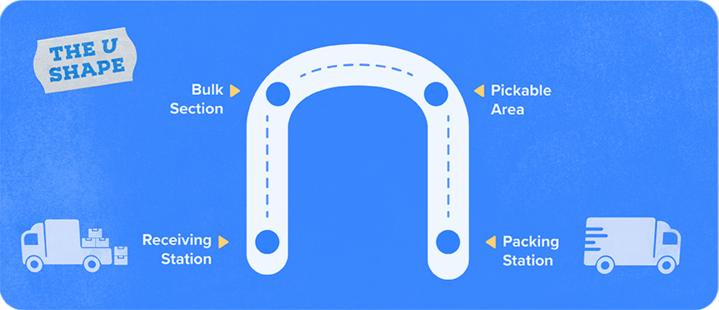
Most warehouses have a square or rectangular shape with receiving and outbound doors on one side, creating a U-shaped flow. There is usually ample space between the dock and receiving area, where products are sorted. Having more room than you need to avoid congestion or delays will come in handy.
Once products are ready to be received, they are taken to the receiving station. This can include fixed or mobile stations, depending on the volume of products being handled. Receiving is a critical aspect of warehousing, and nothing gets past the receiving station if it has not been checked or labeled. Items that pass inspection are ready to be put away, while non-compliant items are labeled accordingly.
The next step in warehouse flow is the bulk section. This is where the overstock pallets are stored until they are needed. From there, products move to the pickable area, where pickers select items for packing. As inventory is moved out of the warehouse, items are moved from the bulk section to the pickable area, where pickers can easily access them.
Pickers typically move around the warehouse with carts, selecting individual units from bins. Once all necessary items have been selected, they move to the packing station. This is where orders are finalized, labeled, and packed into boxes.
After preparing your packages, they will be taken to the outbound dock to be shipped. We typically use collapsible bulk containers for storing outbound items. Choosing a reliable shipping method is important to ensure safe and secure delivery. We recommend reputable options like USPS or FedEx.
An efficient warehouse layout is vital for a successful logistics operation. The layout plays a significant role in productivity, cost-effectiveness, and customer satisfaction, making it an essential factor to consider when setting up a warehouse. Let's look at the various aspects that an optimized warehouse layout can improve.
Understanding warehouse flow is critical to running a successful operation. Utilizing the U-shape flow model and optimized warehouse layout can provide numerous benefits, such as faster material transit time, enhanced productivity, cost optimization, and more. It’s also important to recognize the impact of technology on efficient fulfillment delivery and provide an environment that is safe for employees. Having the proper infrastructure makes a big difference in improving customer experiences and ultimately attaining business success.
If you want to visualize efficient warehouse flow, click here to watch our detailed walkthrough videos for further insights into best practices for warehouse operations.
Warehouse management is the process of overseeing all operations and activities in a warehouse. This generally includes receiving, picking, packing and shipping goods, planning workloads, training staff and handling customer returns.
While warehouse management is barely visible to customers, it’s integral to ensure goods are delivered on time. Good warehouse management ensures every activity is run as efficiently as possible, from maximizing inventory storage to organizing goods for easy picking to ensuring returns are handled professionally.
However, running a warehouse can be costly, especially for smaller eCommerce businesses. Instead of managing their own warehouses, they sometimes hire third-party logistics (3PL) companies. Outsourcing warehouse operations helps eCommerce businesses focus on expansion and sales instead of spending considerable time and resources to manage inventory and take customer orders.
A warehouse management system (WMS) is software that assists you in the warehouse management process. A warehouse management system gives you real-time updates on your inventory levels, warehouse team productivity and order fulfillment progress.
Warehouse management systems are essential for managers because they can use them to gauge work performance and spot improvement areas. They also provide managers with the data and reports to make informed business decisions.
The best warehouse management systems assist your company with five key processes:
One of the primary purposes of a warehouse is to receive and store inventory items from a manufacturer or distributor. Warehouse management systems let you scan and organize each new item upon arrival and storage, so you’ll know which items have arrived and where they're stored.
Inventory tracking ensures you get real-time updates on your stock levels. This helps in determining how many items you can sell and whether you should order more items based on accurate forecasts of consumer demand.
As your eCommerce business grows, inventory tracking will become even more important because you may handle hundreds of goods and dozens of different product types simultaneously. Manual inventory tracking is more prone to human error and may result in costly mistakes.
When employees pick and pack items, they take the goods from warehouse shelves and pack them for shipping. Warehouse management systems can generate picking lists that instruct your warehouse team to pick items as efficiently as possible.
Your warehouse management system also automatically generates shipping labels, which packers attach to products after packing them.
Warehouse management solutions let you track the shipping progress in real time. You can also show the shipping progress to customers so they know where their items are at any time.
Your warehouse management system should provide advanced reporting features that cover order fulfillment accuracy, inventory forecasting and warehouse expenses.
Automating report creation means you don’t have to spend much time gathering data. Instead, you can immediately use the insights from these reports to improve your warehouse operations.
You should use a WMS because manual warehouse management is prone to human error, especially if you run a large eCommerce business.
Here are five other reasons why you should use a WMS:
Warehouse management systems improve your inventory management by monitoring its levels, increasing pick and pack efficiency and improving order fulfillment processes. By automating these various inventory management processes, you’ll get all the information needed to run your warehouse smoothly without spending precious time asking around or looking for data.
While customers don’t directly interact with your warehouse, it plays a big part in their satisfaction. Smooth warehouse operations with the help of a WMS means customers receive orders quickly and accurately. Even if their item is defective, a good WMS can help you handle product returns to ensure customers get their replacement goods quickly.
The right warehouse management software improves your sales and order processing speed without adding new warehouse staff. This means you can process more items and sell more products without a considerable increase in cost, ultimately improving your profit margins.
Warehouse inventory management systems generate reports on essential warehouse performance parameters like order accuracy, orders fulfilled and staff efficiency. By analyzing these reports, your management team can develop plans to improve your eCommerce business further down the road.
In addition to keeping up with customer demand, businesses must also follow local regulations and rules. A good WMS should give you the tools necessary to stay compliant with these regulations by recording real-time data, making your company easier to audit.
Warehouse management systems work by monitoring and automating key warehousing processes. Here’s a look at how warehouse management systems help you in those areas:
Tracking the goods that enter and exit your warehouse is one of the primary functions of a WMS.
For incoming items, the WMS will register them in the system and send the products to the appropriate shelf or container for storage.
For outgoing items, the WMS will show you which shipping service is delivering the products and provide real-time tracking information. The WMS can also show the tracking information to the customer, so they know when their products will arrive.
A WMS helps you track and manage physical inventory levels in the warehouse. When inventory stock starts to get low, the WMS can notify you to order more from the distributor or supplier before stock runs out.
When a customer order comes in, your warehouse crew picks and packs the items to get them ready for shipping. Warehouse management systems create picklists to help your team pick items faster. The WMS also creates shipping labels, so the items can be ready for shipping as soon as they’re packed.
Real-time warehouse reporting is one of the greatest strengths of a WMS. You can easily get insights into your warehouse's operation by generating real-time reports. Instead of spending hours gathering data, you can immediately use this information to make informed decisions and improve your warehouse team’s performance.
While it may be a considerable investment, a warehouse management system pays for itself in many ways. Here are eight great benefits you’ll get by implementing a WMS:
Inventory control involves managing your warehouse’s inventory levels to prevent understock and overstock. Automating inventory control through a warehouse management system means you don’t have to spend time checking inventory levels regularly. Instead, your system will notify you when it’s time to order new products.
Transparency and traceability are essential for both businesses and customers. Tracking where products are in real-time allows you to identify bottlenecks and delays in the supply chain. On the customer side, real-time product tracking ensures they know when their items are arriving.
Some product safety regulations also require your goods to be easily traceable to prevent fraud and counterfeiting. From a safety standpoint, knowing where a product comes from and where it’s going also makes product recalls easier when necessary.
The relationship might not be immediately clear, but a warehouse management system contributes to customer service. Your WMS gives you real-time updates on how many items are in stock and which ones are out of stock, which means customers likely won’t order something that’s out of stock.
Warehouse management improvements help you ship products quicker, satisfying your customers’ demands for fast deliveries.
There are many tasks in your warehouses or distribution centers, like picking and packing orders, loading trucks and handling returns. Your WMS can create these tasks and assign them to the relevant employees immediately based on where they are in the warehouse.
Your software’s task management features also prevent workers from walking from one end of the warehouse to another when completing their work by assigning them to well-defined work zones, increasing overall warehouse efficiency.
Containerization is when you merge multiple individual shipments into a single container to ship together. You can save on shipping costs by sending multiple items in one big batch.
Your WMS assists in containerization by choosing which items go into which container, ensuring they stack well and nothing gets crushed or damaged in transit.
A warehouse management system increases the overall order processing and fulfillment speed by making product picking, packing and shipping more efficient. You can deliver more items to more people by increasing order speed, increasing total revenue and customer satisfaction.
Without a WMS, you may need to create shipping labels manually, which takes a lot of time and effort. A warehouse management system can automatically generate shipping labels, so your warehouse team only needs to attach them to packages before sending them to the carrier.
Labor management features provided by a WMS track your warehouse staff performance in real time, giving you insights into how your team works. Tracking labor lets you identify possible logistics bottlenecks, pinpoint improvement areas and learn which employees may need extra training to succeed.
There are four warehouse management system types, each with unique benefits and drawbacks. Here’s a look at each WMS type:
A standalone warehouse management system is the most basic WMS in this list because it only offers warehouse management features and nothing else. A standalone WMS is usually installed on-site, meaning the vendor will come to your warehouse and install a physical server for the WMS.
Standalone warehouse inventory management software is typically the most affordable due to its limited features, but it may not be enough if you need extra functionality from your WMS. Standalone warehouse management systems are best for businesses without a large software budget and limited warehousing needs.
A cloud-based warehouse management system means the vendor provides its services through the Internet without any physical on-premise installations. Cloud WMS users usually pay a subscription fee to use these services instead of an upfront expense, making them more affordable for new businesses without large premises.
Cloud-based WMS is scalable, meaning you can pay for extra accounts and features if necessary. It’s also easier to update since the vendor can do it online. However, as with most cloud-based services, you need a strong and stable Internet connection to make the most out of a cloud-based WMS.
ERP (enterprise resource planning) is a software bundle that merges numerous business functions like accounting, inventory and human resources in one package. It’s a good choice if you want to merge all your company information into one dashboard that’s accessible by all employees.
While ERP systems often have a warehousing or inventory management module, it’s not the system’s core functionality. Additionally, implementing ERP is often expensive and time-consuming, so you may be better off implementing dedicated warehouse management software if you can’t commit to full ERP implementation.
Supply chain management systems work at a much broader scope than a WMS but generally still provide warehousing features. These modules work best for companies that work with numerous supply chains, like manufacturers and retail businesses.
Choosing the best WMS means picking the one that caters to all of your warehousing needs at a reasonable price. Here are five tips to help you pick the right WMS for your business.
You should first identify what you need out of warehouse inventory management software. Create a list of feature priorities based on your requirements as a guide when shopping for warehouse management systems. Don’t blindly follow the latest warehouse technology trends because what other companies need may not be what your company needs.
Ensure you have a budget before shopping for a warehouse management system. Search for popular WMS providers online, and estimate how much you’re willing to spend on the features you need.
These days, manual demand forecasting can be unreliable, and you may find yourself out of stock in periods of high demand or overstocked in periods of low demand.
If your product demand fluctuates according to the seasons, it might pay to choose a WMS with demand forecasting. A warehouse management system’s demand forecasting can use historical sales to predict popular product demands, letting you increase or reduce orders based on the forecasts.
Purchasing a warehouse management system isn’t a one-and-done deal. You need to build a relationship with the vendor because they’ll provide technical support and apply updates regularly. To pick the right vendor, note how helpful their representatives are and how in tune they are with your needs and requirements.
When shopping for warehousing software solutions, make sure they provide you with room to grow. Ask your vendor representative about how much scalability and customizability their software has – this ensures it can meet your business needs even when your company grows.
A warehouse management system makes your warehouse processes more efficient through various features like automated reports, pick list generation and shipment tracking.
While a good WMS offers many benefits, it’s often a major financial commitment, so you need to choose the right one before implementing it. To do so, you need to identify your company’s needs, define a budget and pick the right WMS provider that can scale with your business.
You can improve warehouse management by measuring your current performance and identifying areas for development. From there, you enhance your warehouse management by:
A WMS (warehouse management system) assists you in the warehouse management process by giving you real-time inventory updates, automatic report creation and demand forecasting, among other features.
The cost of a warehouse management system varies depending on the vendor and the features you choose.
A warehouse management system improves your eCommerce business by helping your team pick, pack and ship more items faster. It also provides real-time visibility into your supply chain to give you a full picture at any moment.
If you want to learn more about warehouse management systems, you’ve come to the right place. Read on for a complete guide on warehouse management systems (WMS).
Here’s a breakdown of what you can look forward to while reading ShipHero’s Guide to Warehouse Management Systems (WMS):
NetSuite is to Finance and IT what ShipHero is to WMS. As a result, NetSuite is used to manage dozens of internal functions that make your business run. However, keeping your warehouse data in sync with your system, giving your customer support team the information they need to resolve customer issues, and keeping your operations running smoothly needs more than a standard WMS. The ShipHero team is thrilled to announce that they have achieved “Built for NetSuite” status for their WMS solution. The “Built for NetSuite” program recognizes solutions that meet the same level of standards for security, data privacy and overall quality as the solutions offered by NetSuite. ShipHero’s WMS for NetSuite solution is a powerful combination of ShipHero’s WMS, embedded tools within NetSuite, and a real-time two-way integration that moves data between platforms. Here are the key areas areas where the NetSuite/ShipHero integration really shines:
You’ll always know what’s happening in your warehouse with the easy-to-read NetSuite dashboard. NetSuite’s dashboard updates in real time, giving you instant awareness of any delays right when they happen. If an order is flagged or an action is taken on a shipment, that information is immediately captured and displayed, giving you the full story of an item’s delivery status.
Never wonder again if the data you’re seeing is accurate. The NetSuite/ShipHero integration allows data to freely move back and forth keeping your inventory counts accurate and helping you to avoid lengthy financial reconciliations on missed inventory or missing shipments.
ShipHero with NetSuite brings you a fully paperless warehouse management experience, cuts down on error rates and waits for manual updates to show in the system. Plus, we can help you better schedule your workforce, to cut down on the number of overtime shifts. One of the best parts is that ShipHero is one of the easiest WMS to learn. Many of our clients have told us that they can get a brand new employee up and running on the mobile app in 15-20 minutes. No more waiting for your team to get up to speed.
ShipHero clients are already leveraging the NetSuite integration to boost their response time and keep customers happy. As an important player in the eCommerce space, ShipHero is committed to working closely with NetSuite to ensure our clients get maximum value from their customer service interactions. Additional features of the ShipHero & NetSuite integration include:
The integration will also be handled 100% in-house by ShipHero, allowing you to go live in as little as 6 weeks without any third party involvement. As ShipHero CEO Aaron Rubin says, “We win because of the quality of our software, the features of our software and our support and ops teams. As eCommerce continues to grow as an industry, close collaboration with our software partners is a top priority.”Get the best warehouse operating system in the business and leverage the power of NetSuite with the backing of ShipHero. Get started now!
ShipHero is a US based, leading provider of an award-winning cloud-based warehouse operating system that gives online retailers and third-party logistics providers the tools to ship more efficiently anywhere in the world. With more than 6,500 customers located around the globe, ShipHero offers online retailers a suite of services ranging from warehouse management software to outsourced fulfillment as a service. Additionally, ShipHero is the official fulfillment network partner for Shopify, and now has 9 owned and operated warehouses across North America to get our clients’ products to their customers faster.
Imagine a colossal warehouse bustling with activity, full of synchronized movement, where goods arrive from various vendors, are stored efficiently, picked accurately, and shipped on time. Amidst the ceaseless flux of goods, from exotic spices to the latest tech gadgets, lies the beating heart of this operation—a Warehouse Management System (WMS). This digital maestro, unseen yet instrumental, ensures everything runs like clockwork. Particularly for Third-Party Logistics (3PL) providers and operations managing multi-client fulfillment, a WMS is a strategic linchpin that turns chaos into order.
A Warehouse Management System (WMS) for Third-Party Logistics (3PLs) and multi-client fulfillment is a powerful software solution that optimizes warehouse operations by offering detailed visibility and control over inventory, labor and space utilization. Think of it as a control tower for your warehouse operations, allowing you to track inventory in real-time, automate complex processes, and manage tasks effectively. In the context of 3PLs and multi-client fulfillment, WMS goes a step further, handling the unique demands and logistical complexity of managing numerous clients with diverse requirements simultaneously.
Need a Warehouse Management System ASAP? Let’s chat!
Managing a 3PL operation without a robust WMS is like navigating an ocean without a compass—nearly impossible. WMS is vital for 3PL operations because it brings a method to the madness of managing varied inventory for multiple clients. It enhances inventory accuracy, reduces order fulfillment errors, and expedites delivery times, all crucial for maintaining client satisfaction and competitiveness in the logistics industry.
The logistics landscape is undergoing a transformative shift towards 'hybrid' warehousing, a blend of traditional warehousing practices with more flexible, on-demand models. The driving force behind this change is the evolving consumer demand and the surge in eCommerce. To thrive in this new era, 3PLs must offer flexible, efficient, and cost-effective solutions to their clients. This is where a WMS shines. By integrating advanced functionalities like artificial intelligence and machine learning, a WMS for hybrid warehousing can streamline operations, forecast demand, optimize labor, and manage complex inventory requirements, enabling 3PLs to stay agile and responsive.
A robust WMS is a game-changer. It can help 3PL businesses attract new clients by showcasing operational efficiency, transparency, and superior service delivery. An advanced WMS demonstrates to potential clients that your business can manage inventory accurately, fulfill orders efficiently, and adapt to sudden demand changes swiftly. And, a WMS provides real-time data, analytics, and reports that enhance visibility into operations, a feature that's highly appealing to clients who want complete control and insight into their supply chain.
A quality WMS system offers comprehensive inventory management. This is particularly crucial for 3PLs and multi-client fulfillment businesses, where managing goods from different clients, products ranging from regular items to hazmat and cold storage, require meticulous control. High inventory visibility in WMS software enables easy tracking of products, whether it's a pallet of apples in cold storage or a container of electronics. The system should support the FEFO (First Expired, First Out) method, allowing businesses to manage perishable goods effectively.
The ideal Warehouse Management System will integrate seamlessly with marketplaces and shopping carts, facilitating omnichannel order fulfillment. The system should support a seamless returns process, handle multiple orders simultaneously, and provide real-time updates on order status. The aim is to bolster customer service by ensuring timely, accurate order fulfillment, which in turn drives customer satisfaction and repeat business.
In the world of 3PLs and multi-client fulfillment, data is king. A powerful WMS software will provide real-time data, offering invaluable insights into warehouse operations. This transparency extends to everything from inventory levels, staff productivity, order status, and returns. Logistics providers can use these insights to fine-tune processes, identify bottlenecks, and ensure maximum operational efficiency.
Every warehouse, whether in the heart of a bustling city or the country's outskirts, has unique needs. The best WMS solutions offer scalability and customization options to match the unique requirements of different businesses. Whether you're a 3PL catering to varied industries or a business managing multiple warehouses, your WMS should scale with your needs. It should also offer customization options, whether it's workflows, reporting, or user interface, ensuring the system aligns with your operational processes and the market dynamics.
ShipHero is revolutionizing the world of 3PL logistics with its powerful and highly efficient warehouse management system (WMS). As a leading provider in the industry, ShipHero boasts features designed to optimize your supply chain operations, from real-time inventory management, advanced order routing, automation rules, to omnichannel support. The user-friendly interface and integrations with popular eCommerce platforms are a testament to ShipHero's dedication to making logistics more manageable for businesses of all sizes. Whether you're a small startup or a large corporation, ShipHero's scalable solution is tailor-made to meet the diverse needs of 3PLs.
OrderFlow is a cloud-based WMS software solution designed to enhance productivity and efficiency in high-volume fulfillment operations. One of the platform's key strengths is its robust integration functionality, allowing seamless access to data from various touchpoints in real-time. Its reporting tools offer actionable insights and transparency to aid in decision-making. A notable feature is the detailed invoicing module, providing accuracy in billing, crucial for the financial health of any business. Interested parties can request a demo to experience its functionality firsthand.
Extensiv is a software platform that addresses the needs of 3PLs and brands for omnichannel fulfillment. Its technology provides comprehensive reporting and data integration options, which ensure transparency and accuracy. The platform is known for its easy-to-use nature, even as it provides extensive functionality. Prospective users can take advantage of a demo to experience the efficiency and productivity that Extensiv can bring to their operations.
HighJump (now Korber) is a well-established player in the 3PL software solutions arena. This platform boasts a variety of modules and tools designed to address the specific challenges faced by 3PLs. From billing and invoicing modules to comprehensive reporting tools, HighJump provides all the necessary elements for success. The platform focuses on ROI, offering cost-efficient solutions designed to boost the bottom line. HighJump's logo is a familiar one in the industry, symbolizing its long-standing reputation for quality service.
Logiwa is a WMS platform that differentiates itself through its advanced analytics and reporting tools. Designed for high-volume D2C and B2C fulfillment 3PLs, the software offers a host of modules that cater to the needs of such operations. The Logiwa experience includes options for customizing functionality based on individual business requirements. Its robust integration capabilities make it a top choice for businesses seeking a solution that can adapt to their workflows. Logiwa also provides periodic updates, ensuring its users always have the most up-to-date tools at their fingertips.
Each client brings a unique set of requirements, and the one-size-fits-all approach doesn't work in multi-client fulfillment. A 3PL WMS offers functionalities that allow operations to be customized for each client, ensuring accuracy and customer satisfaction. It’s all about having options and the flexibility to adapt to client needs.
Inventory management can be a tricky area in multi-client fulfillment. Efficient handling of storage locations and ensuring optimal use of resources are paramount. A 3PL software offers sophisticated inventory management capabilities, providing visibility and traceability for everything from high-demand items to slow movers.
In the world of eCommerce, errors in order fulfillment can cost not just money, but customer loyalty. A good 3PL WMS will reduce such errors, streamline order fulfillment, and integrate with shopping carts to ensure accurate, efficient fulfillment for all clients, regardless of the volume or complexity of orders.
Streamlining warehouse operations is another significant advantage of implementing a 3PL WMS. From labor allocation to real-time updates, a WMS brings a level of efficiency and transparency that boosts productivity and cost-effectiveness.
Integration with various eCommerce platforms is a key functionality of good 3PL software. This allows for real-time information exchange, ensuring inventory levels are accurate across all sales channels and order fulfillment is efficient.
Handling high-volume returns is a part of the eCommerce reality. A 3PL WMS can automate and streamline this process, minimizing costs and improving customer service levels.
3PL WMS offers real-time visibility and comprehensive reporting capabilities, providing critical insights for decision making. This level of transparency is vital for maintaining trust with clients and ensuring operations run smoothly.
Exception management is another area where 3PL software shines. It can quickly identify and address anomalies, preventing minor issues from escalating into major problems.
Implementing advanced technologies like AI and machine learning is made easier with a 3PL WMS. These technologies can optimize various aspects of multi-client fulfillment, from demand forecasting to labor allocation.
Scalability and flexibility are crucial in the ever-evolving eCommerce landscape. A 3PL WMS can scale to meet the growth of your business and offers the flexibility to adapt to changing market dynamics, ensuring you're always one step ahead.
Every business is unique, and your WMS should reflect that. Look for a system that offers customizable functionalities to meet your specific requirements. This might include personalized workflows, adjustable interfaces, or tailored reporting tools.
Your 3PL software should be able to accommodate your business's growth. Scalability ensures that as your operations expand — whether in terms of volume, locations, or complexity — your WMS can easily adapt to the increasing demand.
A WMS that can seamlessly integrate with other systems is a major advantage. This includes your eCommerce platforms, shopping carts, and other logistical or financial software. This not only enhances accuracy but also optimizes overall efficiency.
In the dynamic world of eCommerce, real-time inventory visibility is critical. A quality WMS will provide a real-time view of your inventory across all storage areas, ensuring efficient management and transparency
Data-driven decisions are key to success in today's business landscape. Look for a WMS with advanced analytics and comprehensive reporting capabilities, providing insights to improve operations, forecast demand, and reduce errors.
A user-friendly WMS can significantly reduce training time and increase productivity. Make sure the system is intuitive and easy to use, with a user experience design that is approachable for all levels of users.
Client portals are an excellent way to provide your customers with real-time visibility into their inventory and orders. This transparency boosts customer satisfaction and trust in your services.
Efficient and accurate billing is critical for any business. Choose a WMS with comprehensive billing capabilities to ensure accurate invoicing and improved cost control.
Ensure the software provider offers robust support and service. From initial implementation to ongoing updates and troubleshooting, having a reliable support team can make all the difference.
Finally, consider the cost of the WMS. While it’s an investment, you need to ensure that the cost aligns with your budget and the ROI justifies the expense.
Implementing a WMS can have a profound impact on your warehouse operations. It optimizes various processes, from order fulfillment to inventory management, enhancing overall productivity. Real-time inventory visibility reduces the chances of stockouts or overstocking, while advanced analytics help in informed decision-making. The integration capabilities allow for seamless data exchange, reducing errors and ensuring accuracy. With the support of a WMS, your warehouse can work like a well-oiled machine, ready to meet the ever-evolving demands of the eCommerce landscape.
A robust Warehouse Management System (WMS) tailored for 3PL and multi-client fulfillment is no longer a luxury—it's a necessity. This technology, with its ability to offer real-time inventory visibility, seamless integration, scalability, and customized functionalities, provides businesses with the tools they need to exceed customer expectations and stay competitive. In the end, the choice of a WMS could be the catalyst that propels a business to new heights, just as the right technology choice enabled the transformation of warehouses from simple storage spaces to complex, multi-faceted operations centers that we see today.
3PL fulfillment involves storing products, processing orders, packaging goods, and shipping them to customers on behalf of another business. It includes receiving goods at the warehouse, storing them efficiently, managing inventory, picking and packing orders when a customer makes a purchase, and ensuring the product reaches the customer in a timely manner. Some 3PLs also manage returns and handle customer service related to delivery.
The four types of 3PL providers are:
Fulfillment generally refers to the process of receiving, processing, and delivering orders to customers. It's one part of the broader supply chain process. 3PL, on the other hand, refers to third-party logistics providers who can handle multiple aspects of the supply chain process, which can include fulfillment, but also encompasses other services such as warehousing, transportation, and inventory management. In other words, fulfillment is a subset of what a 3PL provider can offer.
Imagine being the operations manager for a bustling eCommerce business. It's a Monday morning, and your warehouse is brimming with weekend orders. Despite the team's hard work, the traditional, paper-based system struggles to keep up, raising concerns about potential errors that could disrupt the entire supply chain. Amid this chaos, you recall a recent conversation about a digital transformation with a Cloud Warehouse Management System (WMS). Tales of real-time inventory visibility, seamless order management, and increased efficiency linger in your mind. Too good to be true? Nope!
A Warehouse Management System (WMS) is a software solution that streamlines the operations of a warehouse. It efficiently manages tasks such as inventory tracking, order processing, and distribution, providing real-time updates about stock levels and other critical aspects of warehouse operations. These systems can interface with an eCommerce platform, providing essential visibility and control over order fulfillment process.
For eCommerce stores, a WMS is particularly vital. It's the backbone that supports everything from receiving items (each marked with a unique SKU for easy tracking) to the picking, packing, and shipping of those items to customers. Businesses in eCommerce often handle a high volume of orders, returns, and deliveries, making an efficient order management system indispensable.
Warehouse Management Systems are critical for maintaining order in the complex ecosystem of a warehouse. They bring clarity to inventory levels, enabling the warehouse staff to keep up with the dynamic demands of an eCommerce store. By automating tasks, they reduce the chance for human error and increase productivity. Moreover, with supply chain automation, distribution centers can optimize their processes, leading to quicker order processing and customer satisfaction.
Want to talk to an expert in warehouse management? We can help!
Accurate inventory counts are critical to meet customer expectations and manage your products. With a cloud-based WMS, your data is stored in real-time, giving you visibility and control over your inventory levels. Whether your store operates on B2B or B2C marketplaces, this feature ensures you're meeting demand accurately and efficiently.
By integrating with shopping carts and sales platforms, a cloud-based WMS streamlines your order processes. It allows sellers and brands to meet the volumes of orders from multiple marketplaces, providing customers with a consistent shopping experience and maintaining high levels of customer satisfaction.
A Cloud WMS empowers your warehouse staff with tools for better efficiency and productivity. Through mobile and web apps, users gain access to real-time data and insights, enabling quicker decision-making and improved workflows.
Traditional WMS often require substantial hardware and software investments. In contrast, a cloud-based system significantly reduces both shipping costs and overall warehouse costs. With their 'pay-as-you-go' models and fewer needs for on-premises equipment, businesses can save resources and invest them elsewhere.
Integrated with various shipping carriers, a Cloud WMS ensures the swift movement of goods from warehouses to customers. This integration provides real-time shipping data, helping meet customer expectations for fast delivery times.
The automation features of a cloud-based WMS enhance the picking and packing process, reducing errors and increasing speed. This means more accurate shipments, fewer returns, and happier customers.
Automation is at the heart of a cloud-based WMS. Automated processes mean fewer errors, improved productivity, and the ability to scale your operations with flexibility. It takes the manual labor out of tasks like inventory management, order tracking, and reporting, freeing your team to focus on other critical areas.
Upon the arrival of new inventory, a Cloud WMS simplifies the receiving and stowing process. It tracks new products, updates the inventory, and ensures the efficient use of storage space. With real-time visibility and automation, your warehouse operations become seamless and more efficient.
With extensive experience, capabilities, and advanced technology, a dedicated 3PL can take your warehouse management to the next level. It's more than just a service provider; a 3PL is a partner that understands your business requirements and steps in to eliminate mistakes and mitigate risks associated with warehousing and fulfillment.
A 3PL can offer multiple warehouse locations across the country or even around the world. This regional optimization means you can store products closer to your customers, leading to faster delivery times and improved customer satisfaction. This strategic approach to storage and delivery can be a game-changer for your eCommerce business.
By handling aspects such as receiving, inventory management, and order fulfillment, a 3PL provider saves you an immense amount of time. Your workers can focus on other core business areas, knowing that an experienced team is efficiently managing your warehousing operations.
One of the significant advantages of working with a 3PL is access to data and insights. They offer a variety of tools and devices for tracking performance metrics, including inventory status, order accuracy, delivery times, and more. These insights can help guide your decisions, revealing issues that need attention and areas where changes could lead to improved efficiency and cost savings.
As your online store grows in size and sales volume, so do your inventory and order management needs. A cloud WMS should have the capability to scale along with your business, accommodating increasing volumes and adjusting to changes in demand and marketplaces. It should be flexible enough to handle B2B and B2C distribution, dealing with large and small order sizes without affecting productivity and order accuracy.
Every business is unique, with its own set of goals, processes, and challenges. The ideal WMS solution will offer customization and flexibility to suit your specific needs. It should offer you the possibility to adapt your workflows, configure inventory tracking, and adjust order fulfillment processes according to your business model and the category of products you sell.
Another factor to consider is the WMS deployment options. Some businesses prefer on-premises software, but a cloud-based WMS, accessible through a mobile or web app, can offer significant advantages. Cloud solutions usually come with better scalability, seamless integration capabilities, and cutting-edge supply chain automation features.
Issues can arise at any time in the logistics and inventory management domain. That's why it's vital to choose a WMS provider known for its high-quality support services. Look for a provider that offers quick and reliable support to help you resolve any technical or operational problems that might occur.
Lastly, don't forget to check the WMS provider's customer references. These can provide real-world insights into how the WMS solution works, its advantages, and possible issues. Speak to businesses that are similar in size or in the same industry as yours to understand how the WMS software has impacted their operations and growth.
A WMS is instrumental in navigating the choppy waters of inventory management and order fulfillment, ensuring your warehouse operations are efficient and accurate. The benefits it provides are numerous—from improved inventory accuracy and better order efficiency to heightened warehouse productivity and significant cost savings. It allows you to speed up shipping, optimize picking and packing, and even automate receiving and stowing. Yet, just like every lighthouse is unique, so too is every WMS. With the right WMS, your eCommerce business can successfully weather any storm, fulfilling customer demands efficiently and effectively.
The WMS market is diverse, with a variety of vendors offering different types of solutions to meet the specific needs of various industries. These include software companies that provide comprehensive warehouse management software, third-party logistics (3PL) providers that offer WMS as part of their services, and technology companies that provide specialized tools for specific warehouse operations.
A Warehouse Management System can offer numerous benefits. It can help increase productivity by streamlining warehouse operations and processes. A WMS can also enhance inventory control and order accuracy, leading to better customer satisfaction. By automating processes and providing real-time insights, it can significantly reduce errors and operational costs. Furthermore, a cloud-based WMS provides scalability and flexibility, making it easier to adapt to changing market demands and business growth.
Warehouse management activities refer to all tasks associated with managing a warehouse's operations. These include managing inventory levels, tracking and organizing goods, handling inbound and outbound shipments, picking and packing orders, ensuring accurate order fulfillment, processing returns, and maintaining warehouse staff productivity. With the use of a comprehensive WMS, these activities can be coordinated and executed efficiently, leading to more streamlined operations and improved overall performance.
Every client has different logistics needs. If your third-party logistics (3PL) company offers custom pricing, you need to analyze what clients need and offer prices that satisfy their requirements while still being reasonable. However, calculating 3PL service prices individually each time you get a new client takes a lot of time and effort.
3PL pricing templates are here to help you streamline that process. With a template, you can come up with quick cost estimates to show prospective clients to ensure you reach an agreement faster.
Keep reading for a complete rundown of 3PL pricing templates and what components you should include in them. You’ll also find a link to download our free 3PL pricing template!
A 3PL pricing template is a document that helps you determine 3PL service costs. It usually comes in the form of a document or sheet where you can insert various cost items and find the total regular cost of your whole 3PL service.
This template generally includes essential cost items like inbound handling, receiving, storage and order fulfillment. Once you’ve plugged in the per unit price of each cost item, you can check with the prospective client how much of each service they need every month and the sheet will calculate the total costs for you. With a template, you can come up with a quote within minutes.
3PL pricing is calculated by summing up all the relevant cost components. Whatever the total of the inbound handling, receiving, storage and order fulfillment is your monthly 3PL cost for that client. This is the most common way to calculate 3PL pricing, but every logistics provider is unique. You might have extra cost items or considerations that may change how you calculate 3PL pricing.
As a 3PL company, you calculate 3PL pricing for clients. Accurately calculating 3PL pricing means understanding how many products they sell each month, so you can estimate the labor needed to handle their orders.
If you can’t correctly estimate the labor needed to handle your client’s logistics operations, you may overcharge or undercharge on service costs.
What do you put in your 3PL pricing template? The answer differs for every logistics company, but there are common items you’ll find in just about all 3PL pricing templates. Here’s a look at each of them:
Warehousing and storage fees generally make up most of your 3PL pricing structure. This component encompasses receiving, unloading and storage costs for your client’s items.
Many 3PL companies have a tiered price structure for inventory unloading. Generally, unloading larger containers are more expensive than unloading pallets or cartons. This is because containers usually contain multiple pallets or cartons, which means more work to unload.
In addition to unloading, 3PL companies also charge receiving costs. This part of warehousing costs covers the work of inputting the items into the warehouse management system and moving them into the storage space. You can also charge extra for applying shrink wrap to keep the items safe.
The last part of storage fees is the storage charge itself. You can charge by space or by item stored. This cost is usually a recurring fee charged weekly. Some third-party logistics providers also rent pallets if the client ships items in cartons.
As the name implies, picking and packing fees cover the labor when you pick and pack the client’s products. 3PLs usually charge pick and pack fees per item or container, depending on the client’s needs. They also charge a processing fee for every order to be fulfilled.
In some larger orders, fulfillment companies can add shrink wrap as an extra expense for more protection when shipping packages. You can also apply bulk order discounts to improve client satisfaction.
Shipping and transportation fees cover the cost of delivering your client’s products to customers. Your shipping rate can be based on volume, weight, or both combined. You may also offer different shipping rates for various delivery speeds, like two-day and regular deliveries.
If you work with multiple shipping carriers, you can include their names in the template so the client can choose whichever shipping partner works best for their needs and budget.
Before starting to work with a client, you need to set up a WMS and prepare everything for proper logistics management. This is where setup fees come in. It’s a one-time fee you charge when starting work with a new client and it’s usually based on the size of the client’s company and what kind of fulfillment services they need.
Account management fees include document storage, inventory reporting, shipping label printing and other costs required to keep your 3PL operations running. Account management fees are generally small and charged every month.
In addition to all the aforementioned cost items, you can include any additional charges in the pricing template. Additional costs include things like safety charges for storing hazardous materials and refrigeration expenses for perishable goods.
Some 3PL companies may charge seasonal adjustment costs. This cost compensates for the extra labor their team may need to handle the increased order volume during high-demand seasons.
Click to Download Our Free 3PL Pricing Template
A 3PL pricing template is important in business because it helps you come up with price quotes faster. Instead of spending time calculating each cost item manually, you can input the price and quantity into the available slots and get an instant cost estimate. You may still need to adjust the final quote to fit the client’s needs, but it provides a great starting point when discussing a 3PL service offering.
Having all the cost items listed on the template also minimizes human error. If you accidentally skip a cost item in your 3PL service rate calculations, you may end up with an inaccurate quote for the prospective client
Transparency is also a good reason to use 3PL pricing templates. With a fixed template, the prospective client knows how much they have to pay for receiving, shipping and other expenses. This way, they’re more likely to trust your company since they know what they’ll pay for when using your services.
Every client has their preference for 3PL pricing models. Some prefer fixed-price 3PL services, while others think variable pricing is better for their finances. Plus, there’s the Amazon FBA model that has fixed pricing and profit sharing.
How does each pricing model work and what are its benefits and caveats? Let’s take a look:
A fixed pricing model is just as the name implies. Clients pay a set cost to get all your 3PL services. Businesses usually prefer a fixed pricing model if they want to eliminate uncertainty about their 3PL costs. The pricing model's predictability also helps small businesses and companies with thin profit margins stay within budget.
On your side of the deal, using a fixed pricing model fosters a partnership between your company and the client. If you provide excellent 3PL service, your client may see they’re getting more bang for their buck. Additionally, a fixed-price model ensures you get the same amount of money each month regardless of how well the client’s products sell.
However, there is a downside to fixed pricing models. Applying a fixed pricing model means you might take on more work than what the income is worth if the partner company keeps growing. In these cases, you may need to renegotiate the monthly cost with the client to ensure the 3PL company and the client get the most out of this partnership.
A variable pricing model is more commonly used by 3PL companies. Clients often prefer variable rates because they know what they’ll be paying for and can adjust their business operations accordingly. For instance, your client can reduce items shipped to your warehouse if they don’t have enough money to store all of them.
A 3PL pricing template works best when you use variable pricing because you can adjust cost items according to the client’s needs. Using a 3PL pricing template to outline your variable pricing also builds trust since the document covers everything the client is about to pay, ensuring hidden costs won’t blindside them.
The downside to variable pricing models for the client is that it adds a level of unpredictability since how much they pay is determined by their sales. This unpredictability might be a dealbreaker for small businesses wanting to make every dollar count.
Variable pricing models also add a layer of unpredictability on your end since how much you make depends on the client’s sales. You might receive less money during low-demand periods since the client isn’t selling as many goods as they do regularly.
Another pricing model that’s worth noting is the Fulfillment by Amazon (FBA) pricing model. This pricing model works somewhat like a fixed-price model. Sellers pay a regular 3PL services fee, but they also pay a “selling on Amazon fee,” that’s around 15% of the profit margin.
15% of the seller’s profit on top of the fixed fulfillment fees sounds pretty steep. However, sellers sometimes prefer to fulfill orders through Amazon because they can reach a larger audience, use Amazon’s ready-made storefront and potentially gain more sales.
Plus, Amazon is known for its vast fulfillment network. There are over 170 Amazon fulfillment centers and warehouses worldwide, so sellers can sell internationally rather than just domestically. With a large enough customer base, they can offset the increased fulfillment costs of using Amazon FBA.
Another thing sellers need to know about Amazon FBA is its no-questions return policy. Once they sign up for Amazon FBA, they may see an increase in returns.
A 3PL pricing template is a document that assists in calculating 3PL service costs. It contains fillable cost items that you can modify according to the client’s needs, making it much easier to determine how much you’ll charge them.
Your pricing template does more than just help you determine service costs. It also promotes transparency and builds client trust because everything they’ll be paying for is listed on the template, meaning everything is above the board and hidden costs won’t blindside them.
As a 3PL company, you need a robust warehouse management system to ensure you provide the best services to clients. ShipHero’s WMS improves order accuracy, reduces warehouse costs and much more. Contact us today to learn how our WMS can help you succeed.
The advantages of using a 3PL pricing template include increased transparency, reduced human error and faster cost calculations. All three things build client trust because everything is on the table and clients can trust that there won’t be any hidden costs that surprise them once they start working with you.
You can choose the right pricing model for your business by examining your client base first. Small businesses and companies with thin profit margins usually prefer flat-rate pricing because there are fewer surprises. Meanwhile, companies selling products with fluctuating demand might fare better with variable-rate pricing.
Each pricing model has its own pros and cons, so research your clients well and choose the most cost-effective pricing model that suits your capabilities.
A 3PL pricing template helps you improve cost efficiency because it’s easier to review the client’s entire cost structure once the template’s been filled out. You can examine potential overspending and give the client suggestions on how to increase your 3PL services’ cost efficiency.
Behind the scenes of your WooCommerce store, your warehouse dances a fine line between order and chaos. In the midst of this tango, a misstep could lead to a customer service catastrophe. But, what if you could tune your operations to the rhythm of efficiency? This is where a Warehouse Management System (WMS) comes in, turning what feels like a complex labyrinth into a streamlined, well-oiled machine.
A Warehouse Management System (WMS) is specialized software designed to optimize warehouse operations. From inventory management and order fulfillment, to shipping and receiving, a WMS simplifies complex tasks, enhancing efficiency and productivity. This sophisticated tool does more than just count stock quantities; it offers a bird's-eye view of your operations, providing detailed data and analytics right at your fingertips.
WooCommerce is an open-source, customizable eCommerce platform built on WordPress. Renowned for its user-friendly interface and versatility, WooCommerce powers a vast number of online stores worldwide. From Google to LinkedIn, it integrates seamlessly with a myriad of services. And whether it's managing product sales, facilitating purchase orders, or providing unrivaled customer service, WooCommerce is the engine that powers numerous successful eCommerce companies.
Integration of a WMS with your WooCommerce store is no longer a luxury; it's a necessity. With such an integration, you can automate numerous warehouse operations, reducing manual errors and boosting productivity. It can help streamline your order fulfillment process, and integration leads to improved visibility. With a comprehensive view of your inventory across all locations, you can manage stock levels effectively, reducing the risk of overselling or stockouts. Plus, with the insights a WMS provides, you receive valuable insights that can inform strategic business decisions.
Known for its robust and flexible warehousing solutions, ShipHero is a popular choice among WooCommerce users. Its wide range of features includes inventory tracking, order management, 3pl integraion, returns processing, and batch shipping. Designed with an intuitive interface and offering excellent customer support, ShipHero provides all the necessary tools for managing your warehouse operations efficiently. The platform's extensive reporting and analytics capabilities provide valuable insights that help in making informed business decisions.
Zoho Inventory is a comprehensive WMS solution designed for small to medium-sized businesses. It integrates seamlessly with WooCommerce, enabling smooth management of orders, inventory, and shipping. Its powerful features, such as multi-warehouse management, stock adjustments, and automatic reordering, make inventory management a breeze. With Zoho, users also get access to insightful sales reports and analytics, aiding in overall business growth.
Veeqo is another excellent WMS solution for WooCommerce, designed with the needs of small to medium-sized businesses in mind. It offers seamless integration with WooCommerce and features an all-in-one inventory, shipping, and fulfillment solution. With Veeqo, businesses can effectively manage their inventory, process orders, and ship products across multiple channels. The platform also provides insightful reports, helping businesses optimize their operations and grow faster.
When considering a WMS for your WooCommerce store, it's important to take several factors into account.
When searching for a WMS these considerations can help you find one which best fits your store. And while all of these considerations may not be necessary for you today, it is helpful to join a WMS which can offer them in the future as your store grows.
At the top of the feature list for any worthy WMS is robust inventory management. This functionality enables users to track all items in their store, using details like SKU, name, image, and ID. With this, businesses can gain visibility over their inventory, monitor stock levels, and promptly address any shortages.
Efficient order management should not only streamline the order fulfillment process but also provide the ability to track orders from purchase to delivery. The system should allow you to link orders with customers and suppliers, thereby maintaining control over the entire order process.
A good WMS should seamlessly integrate with WooCommerce and other key systems such as accounting software, other eCommerce platforms, and mobile apps. It should allow for CSV data imports and exports, providing flexibility in the way data is used and shared.
The ability to generate comprehensive reports and analytics is a crucial feature of a WMS. From inventory quantities to order statuses, these reports offer valuable insights into various aspects of your business, informing strategic decisions.
If you're running a business with multiple warehouses, then multi-warehouse management is a must-have feature. A good WMS should give you the visibility and control you need over stocks in all locations.
Barcode scanning can be a game-changer in terms of efficiency and accuracy. It helps in speeding up the task of tracking, managing, and controlling inventory, reducing manual errors in the process.
A user-friendly interface is vital for any software application. A WMS should be intuitive and easy to navigate, making it simple for all users, regardless of their level of technical expertise. If a WMS is too complicated the ability for your workforce to begin using it without causing a disruption is low.
Automation can drastically improve efficiency by speeding up routine tasks. A WMS should be capable of automating various warehouse operations, freeing up your time for more strategic work. As you look at different WMS offerings, ask about the automation available within the WMS because not all platforms will have the same automation available.
As your business grows, so will your demands from a WMS. Choose a scalable solution that can adapt to the changing needs and size of your business. If you outgrow your WMS, you risk the chaos that can come from switching to a more robust platform.
Reliable customer support is an often overlooked yet critical feature of a good WMS. Be it resolving queries, troubleshooting issues, or helping with updates, responsive customer support can make the difference between a good and great user experience.
While you want a WMS loaded with features, it's equally important to consider its cost-effectiveness. It should offer a variety of useful functionalities without breaking the bank, offering a good return on investment for your business. The goal of your WMS provider should be to help you save money and run more efficiently!
Need to chat with a WMS expert? ShipHero can help!
ATUM takes WooCommerce inventory management to the next level. It offers comprehensive stock management, product data export, suppliers tab, purchase orders, and the ability to set up locations for your warehouses. It also enables users to control stocks by using a built-in "In/Out" stock control system. This integration is an excellent choice for businesses of all sizes.
This plugin is designed to handle inventory across multiple warehouses or stores. It allows you to manage stock quantities, keep track of warehouse inventory, assign store managers, and automate the shipping process. If you have a business with several physical locations, this could be an ideal solution for you.
Rackbeat provides a smooth WooCommerce integration, offering features such as inventory control, order management, shipping and receiving, and barcode scanning. Its cloud-based nature means you can access your data from anywhere at any time. Rackbeat's interface is user-friendly, ensuring your warehouse operations run seamlessly.
PULPO offers a WooCommerce integration to optimize warehouse management processes. It includes automated order processing, real-time inventory updates, bin location management, and comprehensive reporting. PULPO's aim is to reduce manual tasks and increase warehouse efficiency, making it a solid choice for growing eCommerce businesses.
Ongoing WMS automates several aspects of your warehouse operations. This includes inventory updates, order import, order status synchronization, and more. This real-time integration ensures accurate inventory data and streamlined order fulfillment.
These plugins offer unique features designed to boost the efficiency of your warehouse operations. While each plugin is a powerhouse in its own right, the best choice depends on your specific business needs and operational complexity. Review the features of each plugin and choose one that fits your business the best.
Implementation of a Warehouse Management System (WMS) for WooCommerce can seem daunting, but with a few steps, you can make it a smooth transition.
Integrating a Warehouse Management System with your WooCommerce platform can be a game-changer in managing your eCommerce operations. Not only does it streamline a myriad of warehousing tasks, but it also brings about significant improvements in efficiency, reduces errors, and enhances customer service levels. However, the key lies in choosing the right WMS tailored to your specific needs, budget, and the size of your business, so you can operate like a well-oiled machine!
Warehouse Management System (WMS) features can significantly elevate your WooCommerce operations, providing you with a competitive edge. The advanced inventory management capabilities ensure accurate tracking of stock levels and efficient handling of multiple SKUs. This prevents stock-outs and overstocks, and enhances customer satisfaction.
Choosing the right WMS for your WooCommerce store involves several considerations. Start by identifying your specific business needs. Evaluate the volume of orders you handle, the size of your inventory, and the complexity of your operations. Consider budget, the system’s scalability, and the integration capabilities of the WMS. The WMS you choose should align with your warehouse's workflow and operational requirements.
A mobile app for a Warehouse Management System can considerably enhance warehouse operations. It gives staff real-time access to critical information right at their fingertips. Workers can update inventory data on the go as they receive, pick, pack, and ship items.
Yes, WooCommerce includes an inventory management system that allows you to track stock levels, set stock status, and receive notifications for low stock. WooCommerce also integrates with third-party plugins for advanced inventory control.
Are you tired of juggling numerous inventory lists and feeling like an amateur circus performer every time an order pings your system? If so, let us introduce you to the concept of a Warehouse Management System—not gonna lie, likely to become your new best friend. If you're an eCommerce store owner who is fulfilling their own orders, we’re willing to bet your “storage” situation has spiraled far beyond that single shelf in your garage you started with. No judgment here; it's a sign of success. But when your precious stock is scattered across every square inch of your house, and you find yourself tripping over boxes of widgets on midnight fridge raids, it might be time to get serious about a WMS!
Want to talk to an expert about your needs? Let’s chat!
A Warehouse Management System, or WMS, is more than just a fancy acronym. It's a comprehensive warehouse management solution that streamlines your warehouse operations and manages day-to-day inventory tasks. This software integrates with other key platforms, such as ERP (Enterprise Resource Planning) systems and AIDC (Automatic Identification and Data Capture) hardware, including RFID (Radio-Frequency Identification) technologies. It provides end-to-end visibility of your inventory levels, ensuring you have accurate data at your fingertips. And the WMS systems available range from basic solutions for small businesses to complex platforms for large enterprises.
You’ll need a WMS when your Shopify store starts facing challenges that outgrow basic tools, such as rising order volumes, complex inventory, or fulfillment delays. If you’re dealing with frequent stock discrepancies, managing multiple SKUs or sales channels, or struggling to meet fast-shipping expectations, a WMS helps automate and streamline your operations.
For Shopify merchants, solutions like ShipHero provide robust warehouse management support with features such as automated pick routes, rate shopping, and multi-warehouse syncing. This helps reduce errors, speed up order processing, and provide real-time inventory tracking across locations.
A Warehouse Management System (WMS) is a software solution designed to optimize and automate warehouse operations. It helps businesses manage the flow of goods, from receiving and storage to order fulfillment and shipping, with enhanced accuracy and efficiency.
A WMS enhances warehouse processes, transforming workflows to become smoother and faster. It automates tasks, eliminating redundant steps and reducing the chance for error. This automation includes the use of technology tools like wave picking, zone picking, and batch picking for order fulfillment, improving the productivity of your warehouse staff.
Inventory tracking is a breeze with a WMS. It provides real-time data on your stock levels, allowing you to maintain an optimal inventory at all times. This improved visibility over your stock prevents overstocking or understocking, making sure your warehouse space is used most effectively.
Think of WMS as a financial friend, reducing costs tied to warehouse operations. By streamlining processes and improving inventory control, you’ll be able to make better use of your resources and save money. Plus, with more accurate pricing and cost data, you can make smarter business decisions.
A WMS ensures that the right product reaches the right customer at the right time, every time. By optimizing the picking, packaging, and shipping processes, it enhances the speed and accuracy of order fulfillment, leading to happier customers and repeat business.
Warehouse management software is data-driven, offering a wealth of metrics and analytics to help monitor your business's performance. You can track KPIs, generate reports, and gain insights into your operations, helping you to identify areas of improvement and make strategic decisions.
From receiving orders to shipping goods, a WMS increases the accuracy of every step in your supply chain. By minimizing manual tasks and employing tools like AIDC, errors are reduced, leading to more precise inventory levels and better vendor relationships.
Whether you're a small business owner or running a large company, a WMS grows with your business. It's designed to adapt to increasing inventory levels, additional warehouse locations, and more complex supply chains, making it a sustainable, long-term solution for your warehouse management needs.
Effective space management is key to efficient warehouse operations. A WMS helps you optimize your warehouse layout, ensuring goods are stored efficiently and your team can navigate the space with ease.
With a WMS, your business can comply with industry standards and regulations more effectively. It provides detailed tracking and traceability of items, making recall processes easier if necessary, and enhancing your company's reputation with partners and customers.
By improving accuracy, compliance, and order fulfillment, a WMS also enhances relationships with vendors and customers. More accurate order and delivery data means fewer disputes and more trust from your suppliers and clients.
When automating tasks and providing workers with clear instructions for picking, packing, and shipping, a WMS improves labor efficiency. This helps your warehouse team be more productive, reduces errors, and improves morale.
A WMS enhances the security of your warehouse operations by restricting access to inventory, tracking all movements, and providing comprehensive reporting. This helps protect your valuable stock and ensures only authorized staff handle certain goods or perform specific tasks.
A Warehouse Management System (WMS) comes equipped with a range of features and functions to streamline warehouse operations. From inventory tracking to efficient receiving, picking, packing, and shipping, these tools ensure smooth and accurate management of goods throughout the entire supply chain.
Imagine knowing the exact location of any item, its quantity, and its demand forecast at the touch of a button. With a WMS, you can. Through sophisticated inventory tracking modules, you can maintain optimal stock levels and avoid both under and overstocking issues. This feature is not just a nice-to-have; it's a must-have in today's fast-paced industries.
The efficiency of your warehouse begins at the receiving dock. A good WMS guides your staff through the whole process, from checking the supplier's delivery against the purchase order, to tracking licenses and units, and finally stowing items away. The software can direct your staff to the optimal shelf or pallet, balancing the need for space and the demand for each product. It ensures that everything finds its place, and no material is left stranded.
Picking orders and preparing them for shipment is a critical task in warehouse operations. And a good WMS typically has a pick and pack software that helps you optimize picking routes. Depending on your needs, the system might suggest batch picking, zone picking, or another method that makes sense for your particular situation. The system's goal is to minimize the time your staff spends on the warehouse floor, reduce errors, and streamline the whole process. The result? Happy staff and even happier customers.
Once your orders are ready for delivery, the WMS takes the lead again. It can integrate with various shipping carriers to provide real-time transit updates, and even choose the best shipping option based on your requirements. The system can track thousands of shipments at a time, flagging up any issues or delays.
And finally, what's a good system without a way to monitor its effectiveness? This is where reporting comes in. A WMS provides an array of metrics, allowing you to measure the performance of your supply chain management and identify areas for improvement. In addition, it can even offer yard management features, giving you a 360-degree view of your operations!
Warehouse Management Systems (WMS) operate by integrating various technologies and processes to manage the flow of goods within a warehouse. These systems coordinate tasks such as inventory control, labor tracking, and traceability, ensuring optimal efficiency and accuracy throughout operations.
At its most basic level, a WMS oversees your inventory levels, making sure you have just the right amount of each product. Using advanced automation tools and AIDC (Automatic Identification and Data Capture) technologies, the system can track the movement of materials throughout your warehouse, from the moment they arrive to the moment they leave as part of a customer's order. This real-time visibility into your inventory is invaluable for managing your stock.
A WMS doesn't just oversee materials; it manages tasks and activities as well. It assigns tasks to warehouse staff based on their roles, expertise, and current workload, ensuring the right person is doing the right job at the right time. This can dramatically improve your warehouse's efficiency and reduce errors, a key goal for any logistics operation.
Every bin, pallet, and product in your warehouse leaves a digital footprint in the WMS. This provides unparalleled traceability, making it easy to find any item at any given time. It also helps with order accuracy, as the system can confirm that the correct items are being packed and shipped to customers.
A WMS isn't just about products and orders; it's about people too. The system can monitor your warehouse staff's performance, using KPIs (Key Performance Indicators) to measure productivity, accuracy, and other critical metrics. It provides actionable insights that can help you boost your team's performance, identify training needs, and even assist in resource planning.
In a busy warehouse, every inch of space matters. That's why WMS systems include containerization functions. They can determine the most efficient way to store and ship products, whether they should be on a pallet, in a bin, or in another type of container. This helps maximize the use of your warehouse space and can reduce shipping costs.
Proper labeling is crucial for warehouse operations. It ensures that every item can be easily identified and found when needed. A WMS can generate and print labels that include all necessary information, from product details to barcodes for AIDC.
Choosing the right Warehouse Management System (WMS) requires careful consideration of your business needs and operational goals. By evaluating factors such as budget, scalability, vendor reputation, and system integrations, you can select a WMS that best supports your long-term growth and efficiency.
Every business is unique. The WMS that works wonders for one might not be the best fit for another. So, start by identifying your needs. Evaluate your current workflows, tasks, functions, and areas that need improvement. Do you struggle with inventory management, order fulfillment, or employee productivity? Understanding these requirements will set a solid foundation for your WMS search.
While it's true that a robust WMS can save you money in the long run, it does come with a cost. Establish your budget, considering not just the price of the software, but also any additional costs like training, support, and future upgrades. Remember, a higher price tag doesn't necessarily mean a better fit for your business.
WMS solutions come in various shapes and sizes—from simple tools for small businesses to complex systems for large enterprises. Consider the scale of your operations, your growth plans, and the complexity of your processes when evaluating your options. Don't overlook the benefits of SaaS (Software as a Service) solutions, which offer flexibility and scalability.
Your business isn't static; it's a living, breathing entity that grows and changes. The WMS you choose should be able to scale with you. Whether you're planning to expand your product line, enter new markets, or open more warehouses, your WMS should be able to accommodate these changes without skipping a beat.
The reputation of the WMS vendor plays a significant role in your decision. Do some digging. What do other clients say about them? Are they known for their reliable service, excellent customer support, and regular software updates? You want a partner, not just a provider.
Speaking of customer service, make sure the vendor offers the level of support your business requires. This could range from online resources and email support to dedicated account managers and 24/7 hotline services. Remember, implementing a WMS is a significant change and having a supportive partner can make the transition smoother.
Never buy a WMS without seeing it in action first. Request a demo to get a feel for the system's functionality, usability, and compatibility with your operations. Use this opportunity to ask questions and see how the system handles your specific tasks and challenges.
Your WMS will not work in isolation. It needs to integrate seamlessly with your existing systems—be it your ERP (Enterprise Resource Planning) system, accounting software, or eCommerce platform. Ensure the WMS you choose can play well with others to create a unified, efficient, and transparent operation.
Implementing a new WMS is not an overnight task. It requires time, planning, and resources. Consider your timeline and how long you can afford to have your operations disrupted. Also, ask potential vendors about their implementation process, timeline, and how they plan to minimize disruption to your business.
If you feel overwhelmed with the choices, don't hesitate to seek professional advice. Consultants can provide valuable insights and help you choose a system that meets your needs, budget, and goals.
The goal of a WMS is to make your life easier, streamline your operations, and ultimately, boost your bottom line. And choosing the right WMS solution isn't just about features; it's also about finding a provider that offers the support, integration options, and scalability your business needs to thrive. No more tripping over boxes in your house! Instead get a WMS system to streamline your operations and give you more time back in your day.
Inventory Management is all about maintaining optimal stock levels to meet customer demand without overstocking that could tie up your financial resources. On the other hand, Warehouse Management deals with how things happen in the warehouse, overseeing processes such as receiving, storing, picking, and shipping goods. So, while Inventory Management might tell you what you have and how much, Warehouse Management will tell you where it is, how it gets there, and how to do it all more efficiently.
Warehouse Management Systems come in various types, each designed to meet different business needs and budget constraints:
A WMS is often the backbone of the operations, overseeing everything from receiving products from suppliers, to storing and locating items in the warehouse. With eCommerce, you’re dealing with high volumes of individual orders, often with expectations of rapid delivery. A WMS can help streamline these processes, increasing efficiency and reducing errors.
WMS stands for Warehouse Management System. It’s a software solution designed to optimize and automate the day-to-day operations of a warehouse, including inventory tracking, order fulfillment, and shipping. By streamlining these processes, a WMS helps businesses increase efficiency, accuracy, and scalability in their warehouse operations.
.svg)


.svg)


